Rosslare Europort Terminal 7
SUMMARY
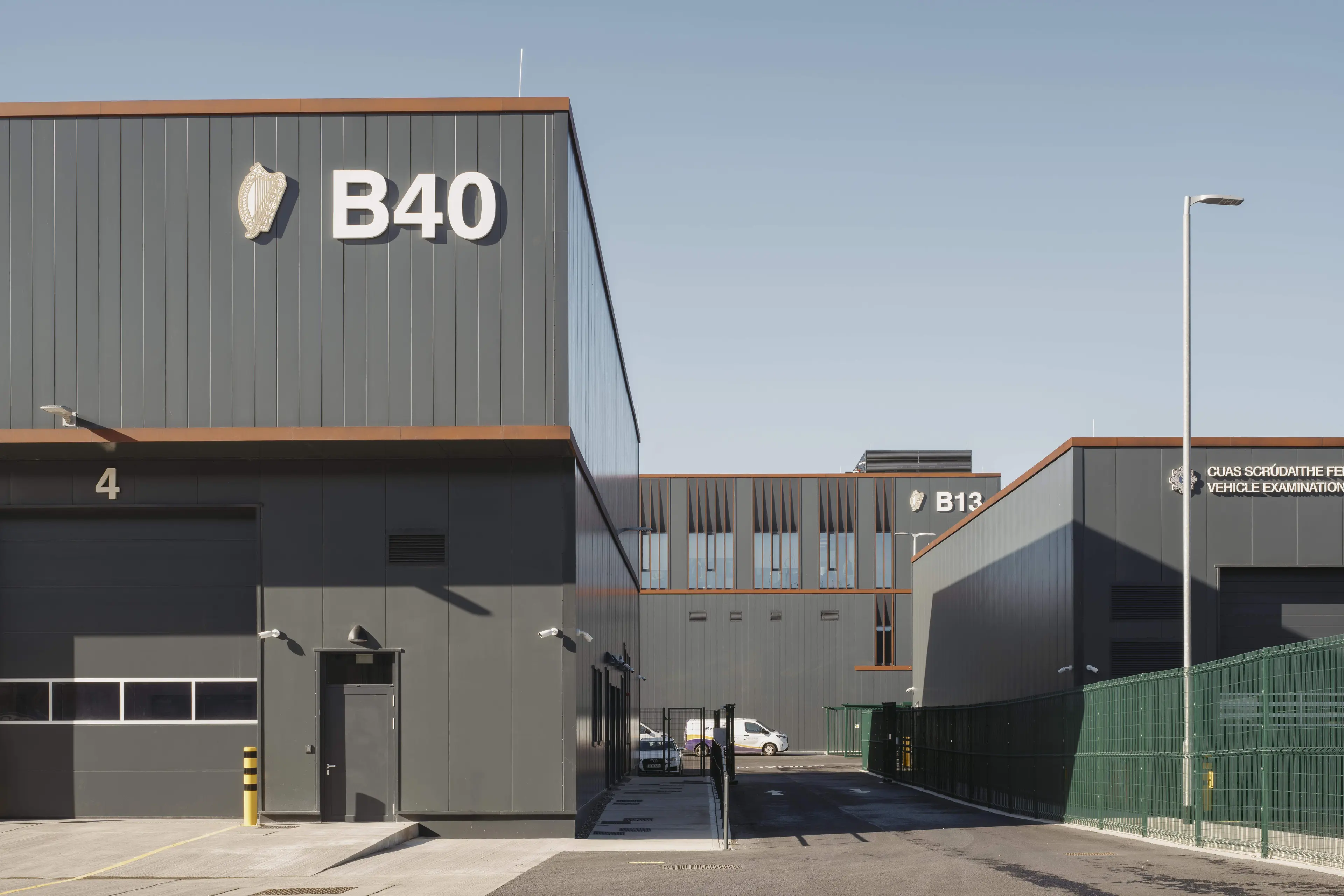
The project, which comprises a campus of 28 new buildings, opened in 2025.
It was designed by Architectural Services within the Office of Public Works, and delivered by John Paul Construction with Reddy Architecture + Urbanism, DBFL Consulting Engineers, SEHA Building Services Engineers.
The construction of the new complex, referred to as Terminal 7, is one of the biggest capital infrastructure investments of its kind undertaken in Ireland. It required the development of c.20 hectares of reclaimed land and the construction of 28 permanent buildings, including Government of Ireland documentary, seal check and physical inspection areas, animal facilities, x-ray facilities, staff administration & welfare facilities, immigration facilities, substations, temporary buildings to enable the development and associated site work. This project was highly complex, with the need to keep the port fully operational for the duration of the works. All parties worked closely with port operator Iarnród Éireann to make that possible.
The project was delivered on time and on budget.
PROJECT OUTLINE
Following the withdrawal of the United Kingdom from European Union, additional checks and controls were required on freight arriving into Ireland.
The Rosslare Europort project was designed in response to these new requirements.
Rosslare Europort is a threshold between Ireland, the rest of Europe, and beyond. It handles both goods from European Union, and other markets. The construction of the new complex, referred to as Terminal 7, is one of the biggest capital infrastructure projects of its kind undertaken in Ireland. The project required the development of c.20 hectares of reclaimed land and the construction of 28 buildings.
This project provided the necessary infrastructure to ensure compliance with EU customs, Sanitary and Phytosanitary and official food controls legislation which arose due to Brexit. This was a critical infrastructure project for the State. It protected the EU Single Market and facilitated continued and streamlined access through Rosslare to the rest of the EU and its population of 450 million people.
This was a complex project due to the scale, programme and environment within which it was delivered – a live, operational port that was experiencing unprecedented growth. Rosslare Europort is one of the busiest ports in Ireland, currently averaging 48 sailings per week across many routes.
The Clients for the project were the Office of the Revenue Commissioners, the Department of Agriculture, Food and the Marine, the Department of Health, Environmental Health Services and An Garda Síochána. This array of government clients, combined with Iarnród Éireann as a key stakeholder, made collaboration vital for success.
DESIGN OUTLINE
The project is located on the south-eastern coast, 18 kilometres south of Wexford town. The site stretches from a railway bridge in the west to a 1980s ferry terminal building in the east. The port is made up of reclaimed land, formed in 1989. The Rosslare railway line winds its way along the southern edge of the port and the N25 road is located to its south.
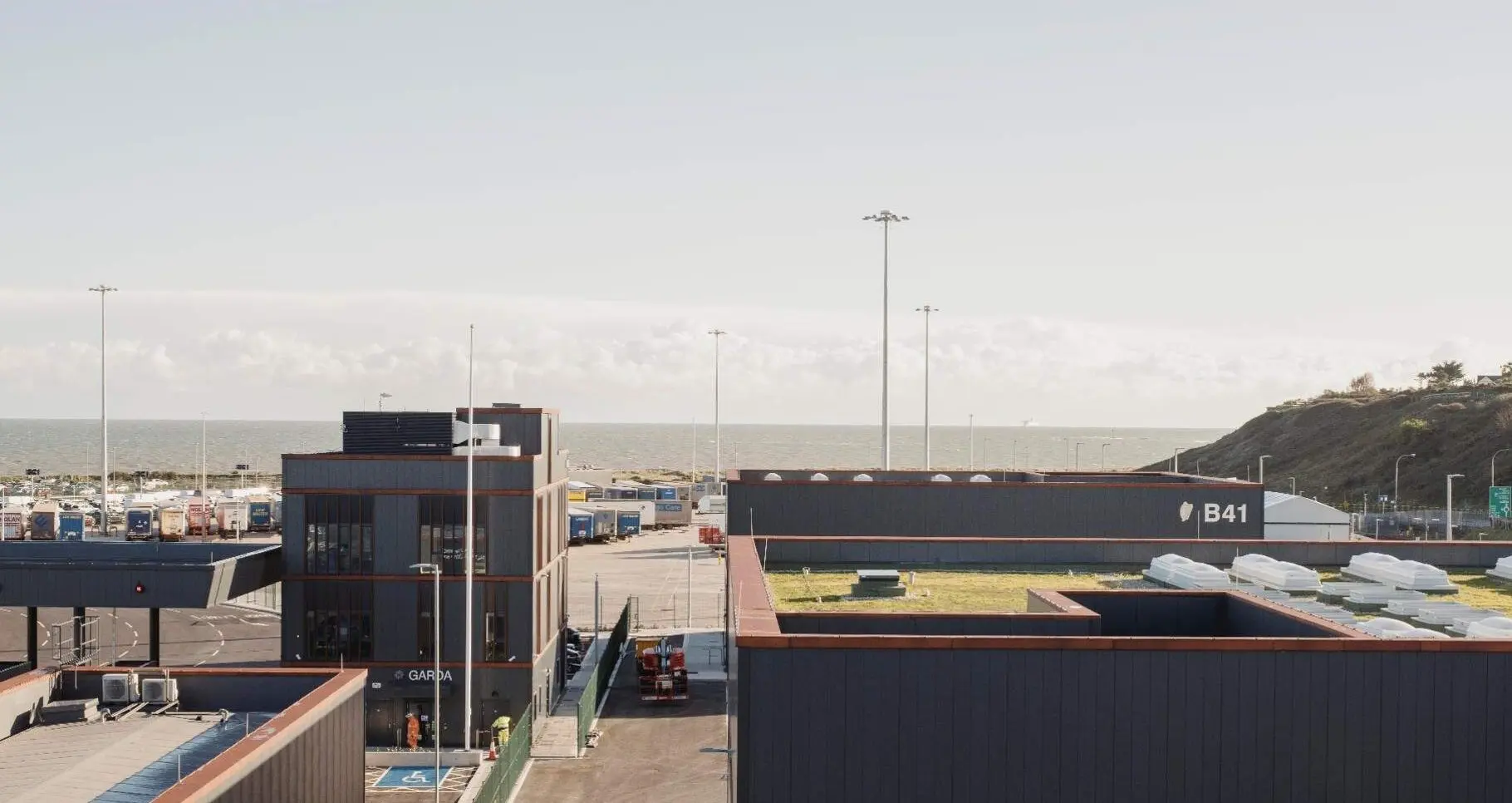
The port sits at a level around 18m below Rosslare village. The location, massing and scale of these buildings have been designed to maintain unobstructed views from the village to the sea, with tallest buildings reaching maximum heights of 16 meters. Due to port needs, truck movements and client requirements, multiple building typologies were required and these are arranged in a campus across the site. This allows glimpses to the workings of the port between the buildings, with the Irish Sea as backdrop. A gradual height transition was created, with single storey buildings located closer to the sea and taller buildings closer to the embankment.
Larger buildings are planned with unloading and inspection facilities at ground floor and offices and administration facilities above. These are complimented by courtyards which provide north and south light, cross ventilation and sea views for surveillance of the port.
Sedum roofs are utilised on larger buildings, visually enlivening and improving biodiversity, while continuing the green belt down the embankment to the new development.
All buildings respond to brief and context, with entrances placed in strategic locations, office spaces with internal and external visual connections and plant areas located for ease of maintenance.
A visual coherence is brought to the project through rigorous detailing at all buildings. Parapets, banding and curtain walling elements complement the existing visual language of the working port landscape including ships, railway line, trailers and rock armour boulders. The specification, material and colour selections for these elements evoke a poetic association with the industrial and maritime heritage of the port and the passage of time. These are tied together by an innovative pavement and concrete yard design.
The rhythm of kiosks and canopies speaks to the metrics of vehicular types and port traffic, while responding to the unique and vital day to day work which takes place in the port. Single and multilevel plinths and kiosks are topped with oversailing canopies, to allow protection and privacy for staff and members of the public.
SUSTAINABILITY
The project is located on reclaimed land in the port. Before works commenced, it was a brownfield site which was previously under-used. The intensification of port usage at this site represents a sustainable approach to development. Site drainage was vastly improved, with petrol interceptors and upgraded civil engineering systems installed.
Sedum roofs were provided on many buildings as part of the works to improve biodiversity and to introduce planting to this industrial port setting.
The buildings achieved a BER rating of A3 and many of the buildings are naturally ventilated.
The project provided local employment both during the construction phase and now in its operational state. The main contractor, John Paul Construction, engaged local suppliers where possible, 40% of whom were located 40km or less from of the site and with only 28% located more than 100km away.
INNOVATION
The successful delivery of the Rosslare Europort project required a structured and disciplined approach to planning, collaboration and innovation due to the scale of the works, the complexity of the sequencing and the requirement to maintain port operations throughout construction.
During the construction stage, Iarnród Éireann introduced the requirement for a significant Smartport technology package. This presented a complex co-ordination challenge, as it involved brand new vehicle recognition systems, trailer tracking, automated check in and check out processes, compound management systems and weigh-in motion technology.
To integrate this, intensive design workshops were held between the project team, Iarnród Éireann, Office of Public Works and specialist technology providers. Interfaces were mapped out, with particular focus on electrical infrastructure, network resilience, cabling routes and operational workflows. The introduction of Smartport systems had implications for layout, services and commissioning sequences, all of which was accommodated within an ambitious programme. This was successfully delivered as a ‘First of Kind’ in Ireland.
MMC
The project made extensive use of modern methods of construction to improve programme certainty, quality and safety. The first phase of buildings used insitu cores with precast stairs. As the team gained greater certainty in their sequencing strategy, later buildings were delivered using fully precast solid cores. This approach reduced on site labour requirements and minimised work at height. Precast elements were also used for architectural features including walls at entry kiosks and boundary walls to cattle pens.
Digital Tools & Co-ordination
Three digital platforms were central to the management and co-ordination of the project: Revizto, Drone Deploy and Autotrack.
Revizto served as the co-ordination environment for all disciplines, enabling clash detection, model-based collaboration and structured issue management. Drone Deploy provided accurate geospatial information and regular progress imagery, with daily flights and weekly 360 video walks. This data supported earthworks verification, commercial forecasting and port logistics planning. Autotrack was used to assess truck and other vehicle movements through each phased handover. This ensured that proposed temporary routes could accommodate all vehicle types safely.
Specialist Equipment Integration
A notable building in the development is the x-ray scanner building. This complex building had unique functions. This made its design, including construction sequencing, operations and logistics challenging. Given the sensitive nature of the equipment, particular care was required to understand installation requirements, commissioning and operational constraints. This equipment is critical and has improved the flow and control of goods entering the State and the detection of contraband in the port.
INNOVATION
Ground Investigation & Foundation Design
An innovative approach was taken to target site investigations, improving the reliability of the ground modelling in an area of reclaimed land of mixed materials. Plate load testing and trial panels informed the pavement design, particularly in areas of variable ground strength. This work led to a change in foundation strategy from driven steel piles to 300mm diameter piles pre-bored using a rotary percussive Odex system. This method ensured reliable penetration through obstructions in the fill and achieved the required rock socket depths.
Pavement & Concrete Yard Design
The concrete yard design considered mix design, slab structure, aspect ratios, reinforcement detailing, surface water drainage and long-term durability. The extensive concrete yards were designed for marine environmental conditions and high traffic loads.
Reinforcement wastage on large concrete slabs is a well-known challenge. The team identified opportunities to reduce waste by adopting bespoke mesh panel sizes. Working closely with fabricators, a three-mesh panel installation strategy was developed for each six-metre bay. The dimensions of each panel included cover requirements, eliminating mesh waste across the 91,000m2 of concrete paving.
IMPACT
These facilities have made a positive impact on port operations and effectiveness.
The x-ray scanner has led to several significant seizures and has assisted the vital work of Revenue in the port. One of the largest on-shore seizures of cocaine ever recorded in Ireland was found in Rosslare in October 2025, just after the opening of this facility. “This was directly as a result of the new scanner” – Revenue
The project provided local employment both during the construction phase and now in its operational state.
John Paul Construction engaged proactively with schools, community groups and local organisations throughout the works. The project supported local initiatives, contributed to environmental activities and invested significantly in the local economy through procurement and employment.
One particularly meaningful contribution was the creation of a 1.5km nature trail at Kilrane National School. This facility has delivered tangible benefits for students, staff and local residents, supporting daily exercise, biodiversity initiatives and community events. Feedback from the school principal expressed appreciation for the professionalism of the team and the long-lasting value of the facility.
The project also supported the Rosslare Harbour Festival, with John Paul Construction helping to repair the car park at St Patrick’s Church and participated in various community activities. The Rosslare Harbour Development Board noted the significant contribution that the project has made to the village and its local amenities.
LOCATION:
Rosslare Europort, Co. Wexford, Ireland
CLIENT:
Office of the Revenue Commissioners
Department of Agriculture, Food and the Marine (DAFM)
Department of Health (DoH)
An Garda Síochána (AGS)
PROJECT TYPE:
Infrastructure
BUILDING SIZE:
Site area 19.5 hectares
SUSTAINABILITY:
A3
PROJECT DURATION:
2 years
ARCHITECT:
Design: Architectural Services OPW
Delivery: ReddyA+U
PROJECT MANAGEMENT:
OPW
MAIN CONTRACTOR:
John Paul Construction
QUANTITY SURVEYOR:
Carron & Walsh
STRUCTURAL ENGINEER:
Design: DBFL, Monitor: Punch
M&E ENGINEER:
Design: SEHA, Monitor: Arup
FIRE SAFETY CONSULTANT:
Design: ORS, Monitor: OPW
DAC CONSULTANT:
Design: ORS, Monitor: OPW
ELECTRICAL SUBCONTRACT:
Tritech
MECHANICAL SUBCONTRACT:
AirconMech