The Shackleton Experience
INTRODUCTION
Athy has a rich and varied history dating back to the medieval period and before. Of its many stories, that of Sir Earnest Shackleton is recognised as being particularly special.
Under the remit of the Heritage Centre Board, the Athy Heritage Centre, now the Shackleton Museum, offered an excellent exhibition about the explorer and his escapades. Every year the Shackleton Autumn School hosts events over a week attracting hundreds of visitors to the town. In 2016 a stunning sculpture of the explorer was unveiled in Emily Square to further celebrate the man who was born just 15km from the site of the Museum.
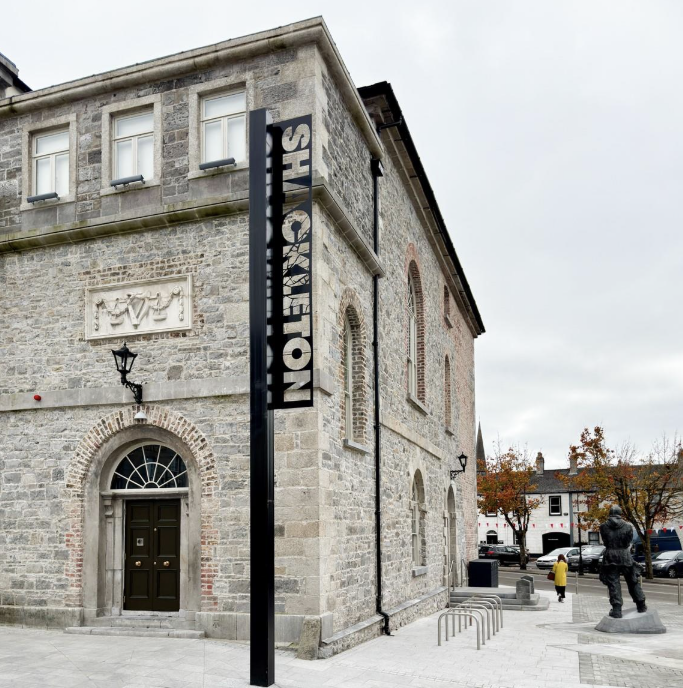
It was recognised that the centre did not fulfil its potential and that visitor numbers could be much higher. Issues that faced the centre included a lack of adequate exhibition space and a dated, poor quality internal appearance. To draw visitors a well-planned, clearly thought out and engaging interpretation would make for a richer experience.
The proposal for the project was to conserve, restore and extend a prominent Protected Structure in the centre of Athy, to energise the town centre and activate a place of commerce, leisure and tourism. This project is one of several delivered in Athy by Kildare County Council, with the investment supporting existing businesses and generating new economic activity.
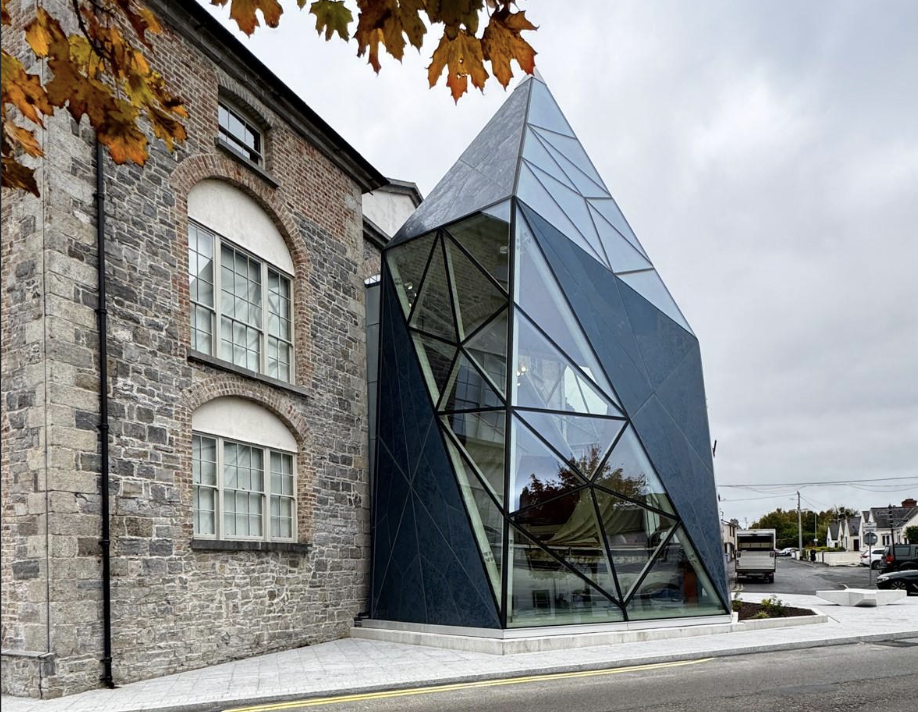
The proposed Shackleton Centre carefully combines a process of detailed building restoration with contemporary flair. An especially innovative piece is the glass extension to the building, the Iceberg, along with the cutting-edge exhibition design and interpretative methods.
BRIEF
The vision for the Shackleton Experience was to build one of the world’s great polar museums, a national and international reference point for the Heroic Age of Polar Exploration, a hub for research and a must-see for polar enthusiasts, cultural tourists, international & domestic visitors alike.
Under the remit of the Heritage Centre Board, the Athy Heritage Centre based in the historic Market House on Emily Square, previously offered an exhibition about the explorer and his expeditions. It was recognised that the centre did not fulfil its potential and that visitor numbers could be much higher. To draw visitors a well-planned, clearly thought out and engaging interpretation would make for a richer experience.
The proposal for the project was to conserve, restore and extend the prominent Protected Structure in the centre of Athy, to energise the town centre and activate a place of culture, commerce, leisure and tourism. The new Shackleton Experience carefully combines detailed building restoration with contemporary flair.
The main purpose of the project was to
- Provide visitors with a unique insight into the experiences of the world’s greatest polar explorer – Ernest Shackleton.
- Increase awareness of climate change and how demonstrate how the great polar regions play their part in the world’s greatest current day challenge.
- Offer research space for interested visitors to steep themselves more deeply in the history of the Shackleton explorations and stories.
- Create an immersive, inspiring, and entertaining visitor experience and acting as a staging post to the town and an area steeped in history and heritage.
- Extend the visitor offer, increasing numbers, spend and dwell time.
- Link the centre with other attractions in Athy Town Centre, so spreading economic return.
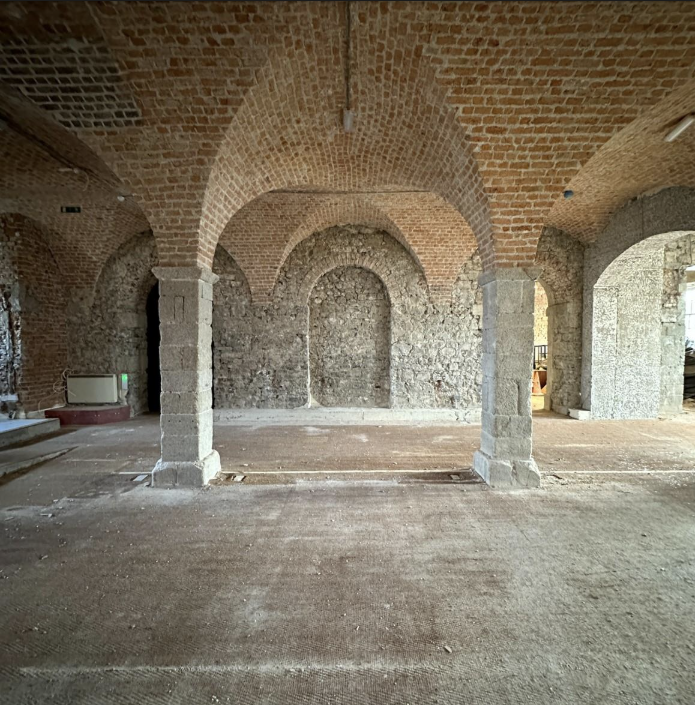
The project reversed previous interventions made to the building to reveal features such as the spectacular brick vaulting to the undercroft. The introduction of the modern ‘Iceberg’ to the southern façade was a striking addition which gives the building a new face, articulated in a clearly contemporary language. The project went to great lengths to repair and conserve the building, breathable lime-based materials, pointing the four street facades and applying a shelter coat to highlight the interior stonework returning some of the beautiful original fabric back to visibility.
Partnered with this was the need for the building to function as a museum space, with a controlled internal environment suitable for the long term and stable display of artifacts and objects.
KEY CHALLENGES
- Compliance With Building Standards
The design of the structural works was a challenge. This involved careful consideration of existing elements of structure to justify them for museum use, however strictly adhering to modern codes of practice for assessing elements that are several hundred years old will ultimately result in their removal, so careful Engineering judgement was required. The interaction of new and historic structure had to be considered to ensure new structural elements didn’t adversely affect the historic elements.
- Site Constraints
The site located in the centre of Athy. The site compound was extremely tight. There was limited space for accommodation, skips and materials. The new iceberg structure occupied the southern side of the site. The eastern side had a live road. The northern side featured a busy square and, for a portion of the project, another construction site. The western side was bordered by another road and a square containing a weekly market and the local courthouse. Deliveries were managed just-in-time and required thoughtful and careful storage within the building to maintain safe access throughout, not affect the programme/sequence of works internally and not damage any of the new materials or new finishes already completed internally.
- Time Limitations
The site constraints resulted in a great deal of works having to take place outside the site boundary. Road closures to the adjoining roads had to be regularly made to facilitate our works. All works to West elevation and roof, installation of The Iceberg and delivery of Shackleton’s cabin all needed closures which at some stages were required for months. Great thought had to be put into to the sequencing of these works and constant communication with KCC, local businesses, and the Gardai was needed to coordinate these traffic diversions. Once received, the works had to be completed within the given time frame of the closure. Also, adherence with the overall programme had to be carefully tracked. (this process is outlined in Q1)
- Budget Adherence
Additional works arose due to the uncovering/discovery of previously unknown issues with the structure. Also, due to the client and design teams’ continuous review of what could be done, as opposed to what should be done, other items were added to the scope throughout the construction stage. Close collaboration with the client’s Project Quantity Surveyor (PQS) was essential to ensure the budget was adhered to throughout the project. All unforeseen issues and client requests were costed in a timely manner to give the PQS adequate time to analyse and assess the costs so an informed decision could be made by the client before issuing an instruction. Regular meetings took place between JSD and PQS to expediate agreement of each additional item.
- Supply Chain Challenges
To mitigate supply chain issues, we engaged reputable conservation and specialist subcontractors with whom we had established relationships. Although this required a slightly higher premium, their reliability ensured quality delivery, which was crucial for this prestigious landmark project. Also, as previously discussed Q1 and Q2, the integration of the nominated Iceberg specialist this did introduce significant complexity and pressure on the programme. The continuation of the iceberg design through to the fabrication and assembly elements were challenging. The early engagement of Waagner Biro was key project success.
- Working on A Protected Structure
The project involved extensive conservation work on a protected structure. For example, the entrance glazing posed challenges due to previously added brick piers that encroached on the design. Resolving this required collaborative efforts among the design architect, conservation architect, structural engineer, and client to agree on removing the piers for aesthetic reasons, despite the additional costs. Another unusual challenge was the installation of Shackleton’s cabin mid project. This took a great deal of planning in conjunction with specialist lift contractors, the artefact specialist who restored the cabin and the mechanical consultants. As the cabin had to be installed before the south gable was closed by the Iceberg, a specially constructed temporary structure had to be built inside the building and the humidity carefully monitored until the mechanical systems were fully commissioned. The specialist M+E requirements have already been outlined in Q2.
- Impact On the General Public And Local Communities
The road closures were no doubt a nuisance to the people of Athy but through careful planning and development of streamlined TMPs, this was minimised as much as possible. The introduction of the Iceberg to the historic building elicited plenty of mixed opinions from the public. Our site management team was always on hand to listen to these opinions as the locals passed by on their errands.
PROJECT FEATURES
The conservation of the Shackleton Museum involved the meticulous restoration of a 300-year-old Town Hall, previously home to the Athy Heritage Centre, Athy Library and Athy Fire Service. The building underwent major refurbishment preparing it for a new purpose. A team of conservation experts worked together to ensure the integrity of the historic building was maintained, restoring the cabin from the ship Quest, installing modern climate control measures to preserve the building and its artefacts. The project successfully integrates old and new, showcasing the historic life stages of the building while delivering a modern building experience through cutting edge technology.
The project looks to undo historic interventions made to the building and return the form and fabric more closely to its original arrangement. With the introduction of the modern ‘Iceberg’ to the southern façade it is important that the clear articulation of what is new and what is historic is made clearly. The project goes to great lengths to repair, consolidate and conserve the building, Breathable finishes, attention to the envelope with appropriate materials and returning some of the beautiful original fabric back to visibility.
Partnered with this is the need for the building to function as a museum space, with a controlled internal environment suitable for the long term and stable display of artifacts and objects.
Key Details
- Return of the original form and spatial relationships.
- Integration of services discretely.
- Using the Iceberg to signal and invite visitors to the building.